Cloudways vs Laravel Forge vs Laravel Cloud: Three Different Products, Not One Comparison
Laravel's own comparison page pits itself against Cloudways and gets Cloudways' price wrong. Here's what each product actually is - a managed host, a server panel, and a serverless platform - verified directly against all three vendors.
This page may contain affiliate links. We may earn a commission if you make a purchase, at no extra cost to you.
The 30-second answer
CHOICEA'S PICK
These aren't three competing versions of the same thing. Cloudways is a managed hosting platform (you get a server, Cloudways runs it). Laravel Forge is a server-management panel ($12-$39/mo flat) that either provisions its own Laravel VPS or connects to your own DigitalOcean/AWS/Hetzner account - you still own the underlying server relationship either way. Laravel Cloud is a fully-managed, pay-per-use serverless platform for Laravel/Symfony apps on AWS only, with no server to manage at all. Pick based on how much infrastructure control you want to keep, not on a vendor's self-comparison.
BEST FOR
- **You want someone else to run your server and you might run something other than Laravel** — Cloudways. It's the only one of the three that isn't Laravel/Symfony-specific.
- **You want full control over a server's configuration, are comfortable choosing (or already have) a cloud account, and want a clean deployment panel on top of it** — Laravel Forge, especially if the per-server-plus-cloud-bill model and BYO-infrastructure control matters more to you than someone else owning the server relationship entirely.
- **You're building a Laravel or Symfony app specifically, don't want to think about servers at all, and are comfortable with usage-based billing that can scale down to near-zero for low-traffic apps** — Laravel Cloud.
- **You're not sure Cloudways itself is the right category yet, regardless of which of these three you're weighing it against** — see [Who Should (and Shouldn't) Use Cloudways](/articles/should-you-use-cloudways/) for that upstream decision first.
What to check next: Check Cloudways' managed hosting plans
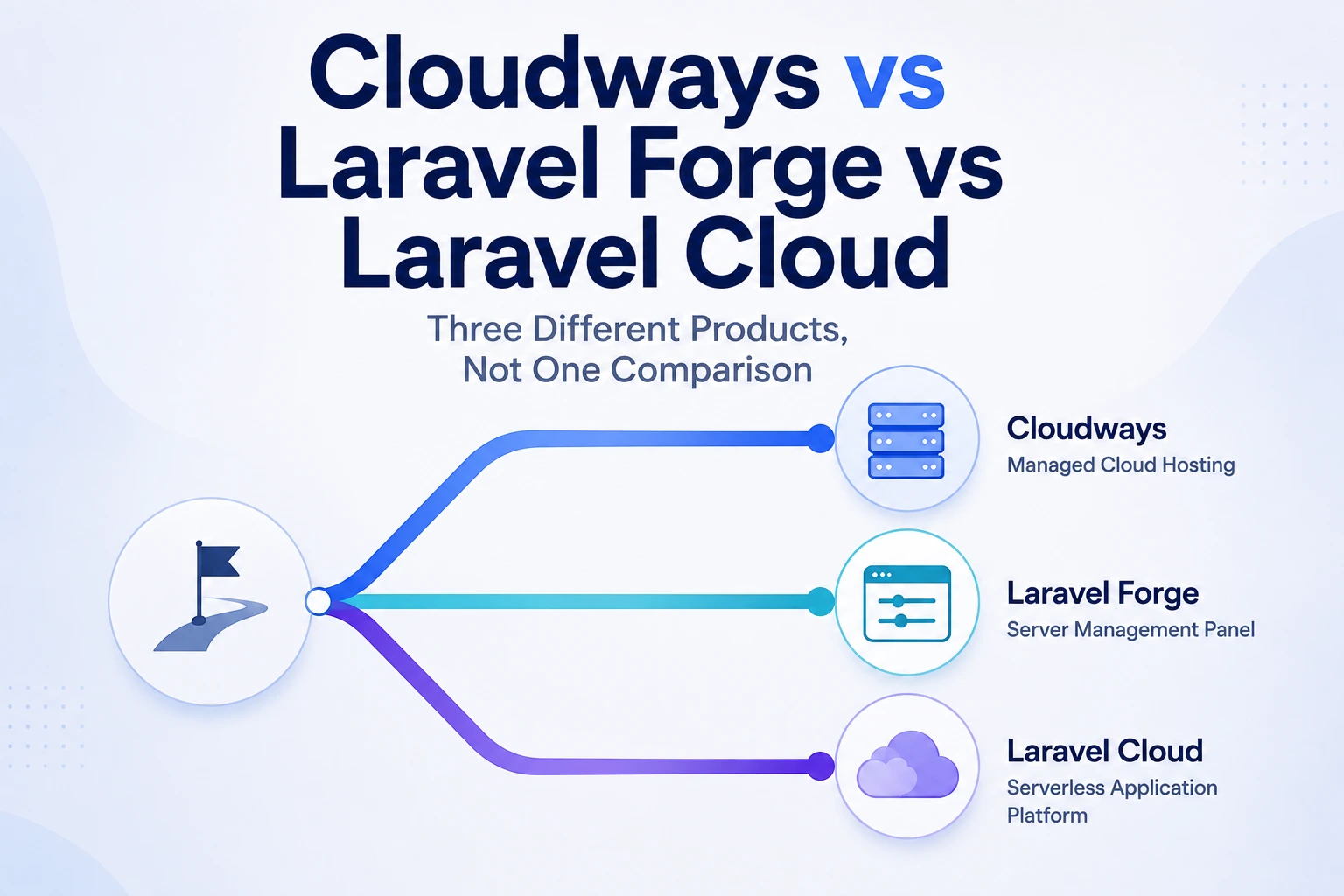
Search for "Cloudways vs Laravel Forge" or "Laravel Cloud vs Cloudways" and you'll mostly find two kinds of pages: Laravel's own official comparison, which frames itself as the outright winner over "Cloudways by DigitalOcean" before showing a single verified number, and Cloudways' own Laravel-hosting page, which naturally doesn't mention Forge or Laravel Cloud at all. Neither is neutral, and — more importantly — neither one clarifies that these are three structurally different products, not three competitors offering the same thing at different prices. We checked all three vendors directly, on 2026-08-26, and found a factual error in Laravel's own comparison that's worth correcting before anyone uses it to decide.
Three different products, not one comparison
The confusion is understandable, because Laravel's own marketing collapses it: their comparison page is titled "Laravel Cloud vs Cloudways," treating Laravel Cloud as the fair fight against Cloudways. But there are really three distinct things a "Laravel hosting" searcher might mean:
- Cloudways — a managed hosting platform. You get a provisioned server (on DigitalOcean, Vultr, Linode, AWS, or Google Compute Engine infrastructure) with a dashboard, security patching, backups, and support layered on top. Laravel is one of several stacks you can run on it.
- Laravel Forge — not a hosting provider at all. It's a server-management panel: either it provisions its own bundled "Laravel VPS," or it connects to a cloud account you already have (DigitalOcean, AWS, Hetzner, and others), and gives you a dashboard for deployment, SSL, and server config on top of that.
- Laravel Cloud — a fully-managed, serverless platform built specifically for Laravel and Symfony apps, hosted exclusively on AWS, with no server for you to see or manage at all.
Only Cloudways and Laravel Cloud are genuinely comparable as "someone else manages my server for me" products. Forge is a different category — a tool you use with a server, not instead of choosing one — which is exactly the distinction Laravel's own "Cloud vs Cloudways" page glosses over by not mentioning Forge in that comparison at all.
What each one actually is
Cloudways: You choose a server spec at signup (starting at the DigitalOcean-based "DO1GB" tier), and Cloudways handles provisioning, security configuration, staging environments, and support. Owned by DigitalOcean since a 2022 acquisition, though Cloudways doesn't brand itself as "Cloudways by DigitalOcean" anywhere on its own site — that phrasing is specific to how Laravel's comparison page refers to it, not Cloudways' own positioning. See CHOICEA's Cloudways review and pricing breakdown for the full picture.
Laravel Forge: Confirmed directly on laravel.com/forge and its own FAQ, checked 2026-08-26 — Forge is explicitly not usage-based and explicitly requires you to either use its bundled Laravel VPS or bring your own cloud account: "Do I need my own server or hosting provider? Yes. You can use Laravel VPS for instant provisioning directly through Forge or connect to cloud providers like DigitalOcean, AWS, Hetzner, and others." Forge gives you zero-downtime deployments, GitHub/GitLab/Bitbucket integration, managed databases, and a dashboard for servers you provision through it — but the underlying compute is either Forge's own Laravel VPS (centrally billed through Forge) or a separate bill from whichever cloud provider you connect.
Laravel Cloud: Pay-per-use with no base subscription fee and a $5 free usage credit for new accounts (per Laravel Cloud's own pricing page, checked earlier this session), with autoscaling and auto-hibernation built in. It runs exclusively on AWS infrastructure and supports Laravel and Symfony applications only — no WordPress, no Magento, no general PHP the way Cloudways or a Forge-managed server can run.
Pricing — checked directly, not copied from either vendor's comparison page
Cloudways starts at $11/month for the DO1GB tier (1GB RAM, 1 vCPU, 25GB storage, 1TB bandwidth), confirmed directly on cloudways.com/en/managed-digital-ocean-hosting.php, checked 2026-08-26. Full tier ladder in Cloudways Pricing Explained.
Laravel Forge uses flat-rate monthly plans, confirmed directly on laravel.com/forge/pricing, checked 2026-08-26:
| Forge plan | Price | Notable inclusions |
|---|---|---|
| Hobby | $12/mo | Unlimited Laravel VPS servers, 1 external (bring-your-own-cloud) server, unlimited sites, community support |
| Growth | $19/mo | 5% discount on Laravel VPS usage, unlimited external servers, standard support |
| Business | $39/mo | 15% discount on Laravel VPS usage, advanced support |
| Enterprise | Custom | Contact sales |
That Forge subscription is separate from whatever the underlying server costs — either Forge's own Laravel VPS billing, or a separate invoice from DigitalOcean/AWS/Hetzner/etc. if you connect an external server. There's no tier at which Forge itself hosts your app the way Cloudways does; you're always paying for a panel plus compute, not for compute alone.
Laravel Cloud has no flat subscription tier — it's metered, pay-per-use, with a $5 free credit for new accounts. That makes a direct dollar-for-dollar comparison against Cloudways' or Forge's flat numbers misleading in either direction: a low-traffic Laravel Cloud app could cost less than $11/mo, while a high-traffic one could exceed it, depending entirely on actual usage.
Where Laravel's own comparison page gets Cloudways wrong
Laravel's official "Laravel Cloud vs Cloudways" comparison page states Cloudways "starts around $14/month for 1 GB RAM, 1 vCPU, 25 GB storage, and 1 TB bandwidth." We checked this directly against Cloudways' own current pricing page for the identical spec, on the same day, and found the actual figure is $11/month, not $14 — a real, checkable discrepancy in Laravel's own comparison content, not a sign that Cloudways changed its pricing since Laravel last updated the page.
The same page also frames Cloudways as lacking "a streamlined push-to-deploy workflow" and needing manual configuration. Checked directly against Cloudways' own Laravel-hosting page (cloudways.com/en/laravel-hosting.php), this is overstated: Cloudways supports Git-over-SSH deployment, automatic deployment via webhooks for zero-downtime updates, Laravel Envoyer compatibility, and pre-installed Git integration — a real automated-deployment path, not purely manual configuration.
None of this means Laravel Cloud is a worse product than Cloudways — the two solve different problems, as the section above lays out. It means a vendor's own comparison page is not a reliable source for a competitor's facts, which is exactly why CHOICEA re-verifies rather than quoting either side's self-comparison directly.
Who fits which product
- You want someone else to run your server and you might run something other than Laravel — Cloudways. It's the only one of the three that isn't Laravel/Symfony-specific.
- You want full control over a server's configuration, are comfortable choosing (or already have) a cloud account, and want a clean deployment panel on top of it — Laravel Forge, especially if the per-server-plus-cloud-bill model and BYO-infrastructure control matters more to you than someone else owning the server relationship entirely.
- You're building a Laravel or Symfony app specifically, don't want to think about servers at all, and are comfortable with usage-based billing that can scale down to near-zero for low-traffic apps — Laravel Cloud.
- You're not sure Cloudways itself is the right category yet, regardless of which of these three you're weighing it against — see Who Should (and Shouldn't) Use Cloudways for that upstream decision first.
What none of the three pages tell you upfront
Laravel's comparison page doesn't mention Forge as an option at all, even though "I want control over my own server" is a real, common reason someone lands on that comparison in the first place — Forge, not Laravel Cloud, is the actual Laravel-team answer to that need. Cloudways' own Laravel-hosting page, understandably, doesn't mention that DigitalOcean owns it or that Forge/Laravel Cloud exist as alternatives at all. And neither Forge's nor Laravel Cloud's pricing page discloses what a typical real-world app actually costs once usage is factored in — Forge's flat fee excludes your separate cloud bill, and Laravel Cloud's pay-per-use model has no published "typical" cost, only a $5 starting credit.
Bottom line
There's no single winner across these three, because they're not competing for the same job. If you want a managed server that can run more than a Laravel app, Cloudways fits. If you want full infrastructure control with a clean deployment panel on top, Forge fits. If you want zero server management at all for a Laravel/Symfony app specifically and are comfortable with usage-based billing, Laravel Cloud fits. Price the three honestly: Forge's flat fee is on top of a separate compute bill, Laravel Cloud's cost varies with usage, and Cloudways' $11/mo figure is real and directly verified — not the $14 Laravel's own comparison page currently states.
If this option fits you
Check Cloudways' managed hosting plansPR / This link goes to our partner's official site (affiliate link). We may earn a commission if you make a purchase, at no extra cost to you. Pricing and promotions may change — please check the official site for current terms.
FAQ
Is Laravel Forge a hosting provider?
No. Forge's own FAQ confirms you still need either its bundled Laravel VPS or your own cloud provider account (DigitalOcean, AWS, Hetzner, etc.) — Forge is a management panel and deployment layer on top of a server, not the server itself.
Is Cloudways cheaper than Laravel Forge?
They're not directly comparable the way that question implies — Cloudways' $11/mo includes the server itself, while Forge's $12/mo Hobby plan is a panel fee on top of a separate server cost (either Forge's own Laravel VPS billing or your own cloud provider's bill). A fair total-cost comparison has to add Forge's plan price to whatever the underlying server actually costs.
Does CHOICEA have an affiliate relationship with Laravel Forge or Laravel Cloud?
No. This comparison carries a Cloudways CTA only; the factual corrections to Laravel's own comparison page above stand regardless of which affiliate programs are active, and were checked against primary sources on both sides.
Can I run WordPress on Laravel Forge or Laravel Cloud?
On a Forge-managed server, yes — Forge is stack-agnostic once you're using your own server (or Laravel VPS), so a non-Laravel app is possible if you configure it manually. Laravel Cloud is Laravel/Symfony-only, with no path to running WordPress or other stacks on it.
Sources
- laravel.com/forge and laravel.com/forge/pricing — Forge's product FAQ, "usage-based pricing" and "own server or hosting provider" answers, and the Hobby/Growth/Business tier table, fetched directly and checked 2026-08-26
- laravel.com/cloud/cloud-vs-cloudways — Laravel's own comparison page, including the $14/mo Cloudways figure and the "manual configuration" framing, fetched directly and checked 2026-08-26
- cloudways.com/en/managed-digital-ocean-hosting.php — Cloudways' actual $11/mo DO1GB tier, fetched directly and checked 2026-08-26
- cloudways.com/en/laravel-hosting.php — Cloudways' Git/webhook auto-deployment and Envoyer support, fetched directly and checked 2026-08-26
- CHOICEA's own Cloudways Pricing Explained and Who Should (and Shouldn't) Use Cloudways — referenced here rather than re-derived
Checked at: 2026-08-26, all three vendors. Pricing and product structure change on any provider — confirm current terms directly before deciding, especially Laravel Cloud's usage-based costs, which depend entirely on your own traffic.