Cloudways vs Vultr: Managed Layer or Raw Infrastructure?
Cloudways can provision its managed layer on top of Vultr's own infrastructure — so "Cloudways vs Vultr" isn't really two competing hosts, it's a managed-vs-raw decision. Here's what that actually means for your price and your workload.
This page may contain affiliate links. We may earn a commission if you make a purchase, at no extra cost to you.
The 30-second answer
CHOICEA'S PICK
Cloudways and Vultr aren't directly comparable products — Cloudways is a managed layer that can run on top of Vultr's own infrastructure, among other providers. If you want someone else handling security, backups, and support, Cloudways' managed layer is the fit; if you're comfortable administering a server yourself and want Vultr's broader regional footprint at a lower price, go directly to Vultr instead.
What to check next: Check Cloudways' Vultr-based plans
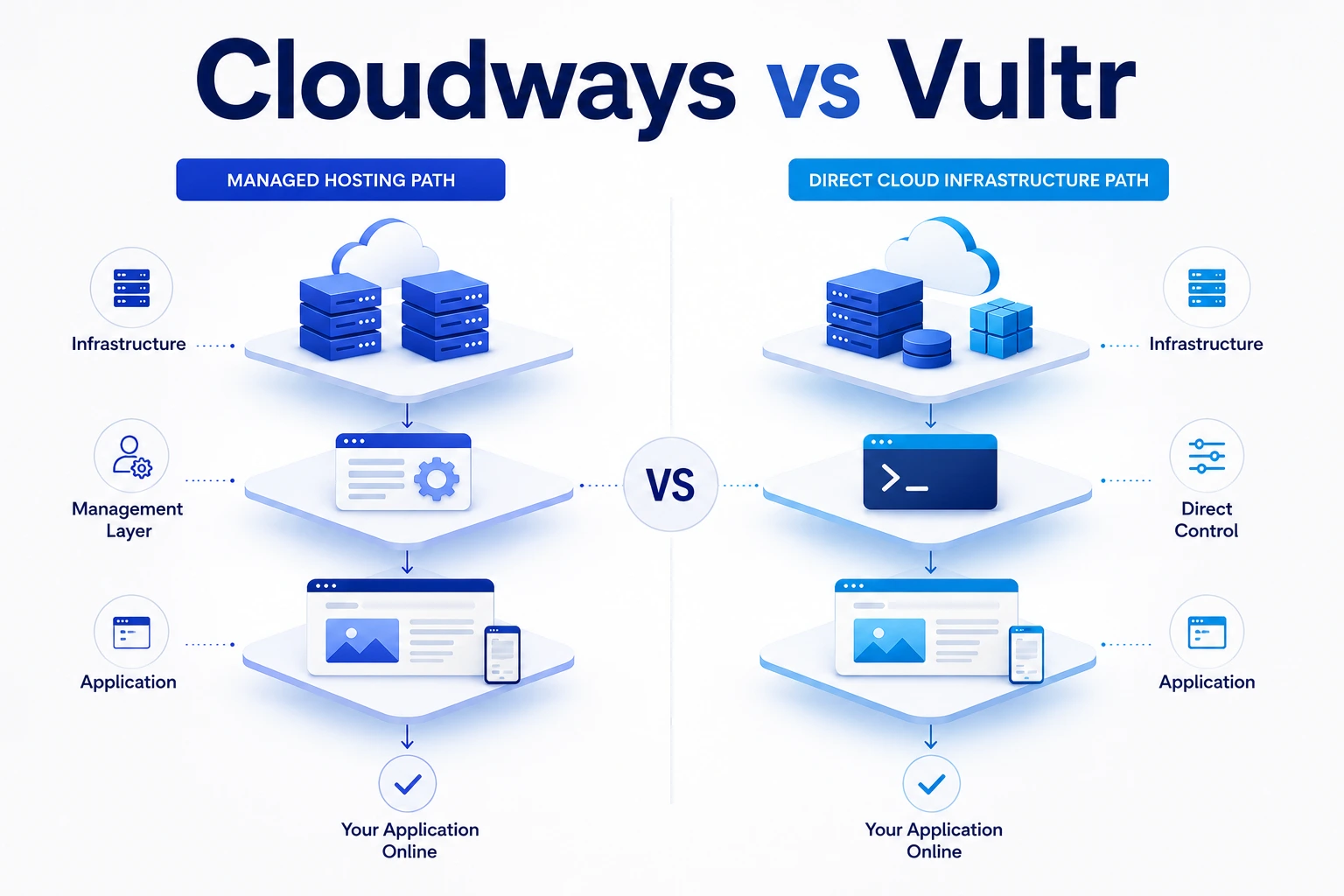
"Cloudways vs Vultr" sounds like a straightforward two-way comparison, but it isn't one. Cloudways doesn't run its own data centers — it provisions servers on top of several infrastructure providers, and Vultr is one of them, alongside DigitalOcean, AWS, Linode, and Google Compute Engine. That means the real question underneath this search isn't "which company is better," it's "do you want a management layer on top of raw infrastructure, or do you want the raw infrastructure directly, without that layer." This page answers that question with pricing verified directly against both companies' own current pricing pages, not estimated or assumed.
This Is a Managed-vs-Raw Question, Not a Feature Fight
Most "X vs Y" hosting comparisons put two directly competing products side by side and score them on the same feature list. That doesn't work cleanly here, because Cloudways and Vultr aren't peers in that sense — Cloudways is a managed platform that can be provisioned using Vultr's own servers as the underlying infrastructure. Choosing "Cloudways" isn't a rejection of Vultr; it can mean choosing Vultr's hardware with Cloudways' dashboard, support, and security layer added on top of it, at a higher price than provisioning that same Vultr capacity yourself.
So the actual decision isn't "Cloudways or Vultr" as if they're mutually exclusive — it's "do you want to pay for the managed layer, on whichever infrastructure it happens to sit on, or do you want to skip that layer and manage a Vultr server yourself." Keeping that distinction explicit is the main thing a lot of comparison content covering this pairing gets structurally wrong.
The Real Price Gap, Verified on Both Sides
An earlier version of this page could not confirm Cloudways' Vultr-specific pricing or fetch Vultr's own pricing page directly, and said so plainly rather than guessing. Both are now verified first-party, fetched directly on 2026-09-17.
Cloudways does publish a separate, Vultr-specific price ladder — it is not the same as its DigitalOcean-Standard pricing. And Vultr's own "Regular Performance" Cloud Compute tier turns out to match Cloudways' Vultr-Standard specs exactly (identical RAM, vCPU, storage, and bandwidth at every tier we checked, not just similar-sounding plan names), so this is a genuine like-for-like comparison:
| RAM | vCPU | Storage | Transfer | Cloudways (Vultr-Standard) | Vultr direct (Regular Performance) | Difference | Raw premium |
|---|---|---|---|---|---|---|---|
| 1GB | 1 | 25GB | 1TB | $14/mo | $5/mo | +$9/mo | 180% |
| 2GB | 1 | 55GB | 2TB | $28/mo | $10/mo | +$18/mo | 180% |
| 4GB | 2 | 80GB | 3TB | $54/mo | $20/mo | +$34/mo | 170% |
| 8GB | 4 | 160GB | 4TB | $99/mo | $40/mo | +$59/mo | 147.5% |
Prices checked 2026-09-17 on cloudways.com/en/pricing.php (Vultr tab, Standard server type) and vultr.com/pricing (Cloud Compute → Regular Performance). Cloudways was showing "4 Free AI Copilot Credits" as a plan inclusion at the time of this check — not a price adjustment, so it isn't reflected in the table above.
Two things worth being explicit about. First, Cloudways-on-Vultr costs more than Cloudways-on-DigitalOcean at matching RAM — $14 vs $11 at 1GB, $28 vs $24 at 2GB, $54 vs $46 at 4GB, $99 vs $88 at 8GB (DigitalOcean-Standard figures from our Cloudways pricing breakdown) — so the two infrastructure choices are not priced identically inside Cloudways, contrary to what this page previously assumed in the absence of direct data. Second, the raw premium over going directly to Vultr (147-180% across these tiers) runs higher in percentage terms than the DigitalOcean-Standard premium at the same RAM sizes (55-100%) — a real, verified difference, not a rounding artifact of slightly different specs, since the RAM/vCPU/storage/transfer match exactly on the Vultr side.
What the Managed Layer Actually Buys
Cloudways includes 24/7/365 support and free SSL on every plan, per its own current pricing page — and adds server provisioning and maintenance, migration tooling, firewall and security configuration, built-in caching, staging and cloning environments, and a web dashboard in place of raw command-line access. That's the same list of what the managed premium buys regardless of which underlying provider (DigitalOcean, Vultr, or another option) Cloudways provisions on top of — see the full breakdown, including the exact dollar gap at each server size for the DigitalOcean-based option specifically, in our Cloudways pricing breakdown. If you choose raw Vultr instead, none of that is included — you're doing all of it yourself.
Where Vultr's Raw Infrastructure Pulls Ahead
If your priority is going raw rather than managed, Vultr has one clearly verified structural advantage over the alternative most people compare it to: regional footprint. Vultr operates in 33 cloud data center regions, per a company press release independently corroborated by Wikipedia's entry on the company, more than double the 13 regions DigitalOcean currently operates in (confirmed directly from DigitalOcean's own regional-availability documentation — see our DigitalOcean vs Vultr comparison for the full regional breakdown). If low latency to a specific market or broader data-residency options matters for your workload, that's a real, verified reason to lean toward Vultr specifically among raw-infrastructure providers — a reason that exists independent of whether you're also weighing Cloudways.
We don't have independently verified, apples-to-apples performance benchmark data comparing Vultr's raw servers to Cloudways-managed servers on the same hardware — neither company publishes this in a directly comparable format, and we're not going to estimate a winner from unsourced claims. If raw performance at your specific workload is the deciding factor, test both directly rather than relying on either company's marketing claims or ours.
Who Should Go Raw With Vultr
- You're comfortable with server administration — SSH, package management, your own security patching and backup schedule — and want to minimize recurring cost.
- Regional reach specifically matters for your workload, and Vultr's 33-region footprint is a real fit for where your users actually are.
- You don't need a dashboard, staging environments, or bundled support, and would rather manage that yourself or with your own team.
Who Should Stay With Cloudways
- You want 24/7 support, security configuration, backups, and staging tools handled for you, regardless of which infrastructure provider sits underneath.
- You're not looking to become your own sysadmin, and the managed premium (see the exact dollar gap by server size in our pricing breakdown) is worth it for the labor it replaces.
- You want the option to switch underlying infrastructure providers later without re-platforming your management tooling — Cloudways' dashboard stays the same across DigitalOcean, Vultr, AWS, and its other supported providers.
Decision Matrix
Your priority
- Lowest possible recurring cost, comfortable self-managing
- Broadest regional footprint for a raw-infrastructure workload
- Want support, security, backups, and staging handled for you
- Want to compare the managed premium on a specific, verified spec ladder
- Still deciding whether managed or raw is the right category at all
Lean toward
- Vultr direct
- Vultr direct (33 regions, verified)
- Cloudways
- See our Cloudways pricing breakdown (DigitalOcean-Standard figures)
- See VPS vs Managed Cloud vs Fully-Managed WordPress
If a comparison-table option caught your eye
See Vultr's current plansPR / This link goes to our partner's official site (affiliate link). We may earn a commission if you make a purchase, at no extra cost to you. Pricing and promotions may change — please check the official site for current terms.
If this option fits you
Check Cloudways' Vultr-based plansPR / This link goes to our partner's official site (affiliate link). We may earn a commission if you make a purchase, at no extra cost to you. Pricing and promotions may change — please check the official site for current terms.
FAQ
Does Cloudways actually run on Vultr's infrastructure?
Yes — Vultr is one of several infrastructure providers Cloudways offers alongside DigitalOcean, AWS, Linode, and Google Compute Engine, per Cloudways' own current pricing page.
Is Cloudways-on-Vultr priced differently from Cloudways-on-DigitalOcean?
Yes — confirmed directly on Cloudways' pricing page. At matching RAM, Cloudways-on-Vultr costs $3-11/mo more than Cloudways-on-DigitalOcean (e.g. $14 vs $11 at 1GB, $99 vs $88 at 8GB). See the matched-spec table above for the full breakdown.
Is raw Vultr cheaper than Cloudways?
Yes, and now with exact numbers: 147-180% more expensive on Cloudways at the tiers we checked (1GB-8GB), verified against both companies' own pricing pages. Whether that gap is worth paying depends on how much you value not doing the server administration yourself; see our managed hosting break-even framework if you want to work through that trade-off with your own numbers.
Which one should I pick if I'm not sure I want to self-manage?
Lean Cloudways. The whole point of the managed layer is that you don't have to be sure — it's built for exactly that uncertainty. If you're confident you're comfortable managing a server yourself, raw Vultr (or DigitalOcean — see our Cloudways alternatives guide) is the lower-cost path.
Sources
- cloudways.com/en/pricing.php (Vultr tab, Standard server type) — fetched directly, checked 2026-09-17 (Cloudways-on-Vultr pricing ladder, 1GB-8GB)
- cloudways.com/en/managed-digital-ocean-hosting.php — fetched directly, checked 2026-08-25 (DigitalOcean-Standard pricing ladder, for the cross-provider comparison)
- vultr.com/pricing (Cloud Compute → Regular Performance) — fetched directly, checked 2026-09-17 (Vultr's own raw pricing ladder, 1GB-8GB; a prior version of this page could not fetch this page directly and relied on third-party summaries — that limitation is resolved as of this check)
- Vultr regional-expansion press release ("33rd Cloud Data Center Region in Milan, Italy") and Wikipedia's Vultr entry, and docs.digitalocean.com/platform/regional-availability/ — region-count figures, checked 2026-08-23, carried forward from CHOICEA's existing DigitalOcean vs Vultr research
Checked at: 2026-09-17 (Vultr-side and Cloudways-on-Vultr pricing); 2026-08-25 (DigitalOcean-Standard figures); 2026-08-23 (regional-footprint figures). Hosting prices, regional availability, and provider offerings change — confirm current terms directly with each company before making a decision.