Managed Hosting Break-Even: When Does Convenience Actually Pay Off?
Managed hosting always costs more per month than raw infrastructure — that part is measurable. Whether it's worth it depends on the value of the time it saves you, which isn't the same for everyone. Here's a transparent framework to work out your own answer, not someone else's number.
This page may contain affiliate links. We may earn a commission if you make a purchase, at no extra cost to you.
The 30-second answer
CHOICEA'S PICK
There's no universal dollar figure where managed hosting "becomes worth it" — the real break-even is when the managed premium you'd pay costs less than the value of the time and risk you'd otherwise be taking on yourself, and that depends entirely on your own hourly rate, your actual technical comfort, and how much a bad incident would cost you. Use the framework below with your own numbers, not a generic one.
What to check next: See the full breakdown above
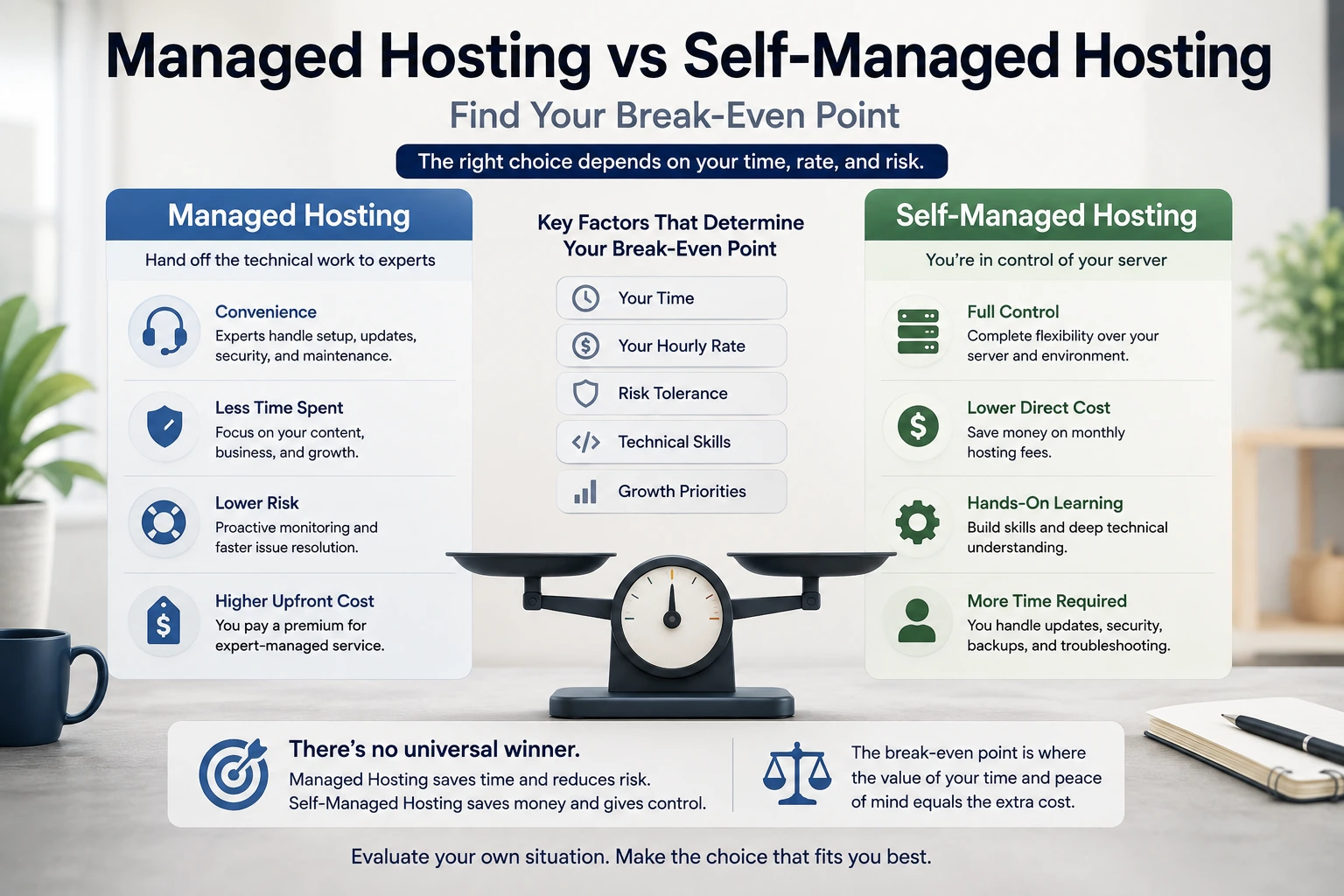
Managed hosting costs more than raw infrastructure — that's a fact, not a debate. Whether the extra cost is worth it is a genuinely different question, and it doesn't have one answer, because it depends on variables that are different for every reader: how much your time is worth, how much time you'd actually spend, and how much a mistake would cost you. This page is a framework for working out your answer, not a claim about what the answer generally is.
What This Page Is (and Isn't)
This is not another explainer on managed vs. unmanaged hosting as a category — see VPS vs Managed Cloud vs Fully-Managed WordPress if you haven't yet decided which structural model fits your situation at all; this page assumes you're choosing between the raw and managed version of infrastructure you've already identified as a fit. It's also not a provider-picking guide — see Best Managed WordPress Hosting once you've decided managed is the right call and need to choose which managed host. And it isn't a named cross-provider cost comparison (DigitalOcean vs Cloudways vs Kinsta, dollar-for-dollar) — that's a different, provider-specific analysis, not the economic-threshold question this page focuses on. This page is specifically about the decision threshold: at what point does paying a managed premium become the economically rational choice, independent of which specific providers you're weighing.
The Real Question Isn't Sticker Price
"Managed hosting costs $X more per month" is a real, measurable number — but it's not the actual decision. The actual decision is whether that extra monthly cost is smaller or larger than the total cost of doing the management yourself, and self-management has real costs that don't show up on an invoice: your own time, the risk of a mistake, and the mental overhead of being the person responsible when something breaks at an inconvenient hour. A framework that only compares the two sticker prices is comparing the wrong things.
The Break-Even Framework
[CHOICEA MODEL] — this is a decision framework built to expose its own assumptions, not a verified formula with one correct answer. Every input below is something you supply based on your own situation:
Managed hosting is the economically rational choice when:

  Managed Premium  <  (Hours You'd Spend Self-Managing × Your Hourly Rate)
                       + Risk-Adjusted Cost of a Bad Incident

Where:
  Managed Premium = the real dollar gap between managed and raw
                     infrastructure at your server size (a real,
                     checkable number — see below)

  Hours You'd Spend = time on setup, patching, security updates,
                     backups, monitoring, and incident response —
                     THIS IS YOUR ESTIMATE, not a number we're
                     supplying for you

  Your Hourly Rate = what your time is actually worth to you — your
                     salary equivalent, your billable rate, or
                     honestly, what you'd pay someone else to do this
                     instead

  Risk-Adjusted Cost = (probability of a serious incident in a given
                     month) × (what that incident would actually cost
                     you in downtime, lost business, or emergency
                     recovery help) — necessarily a rough estimate,
                     and one only you can reasonably judge for your
                     own site's stakes
If the left side is smaller, managed hosting is the rational economic choice for the numbers you plugged in. If the right side is smaller, self-managing is rational — provided you genuinely have both the skill and the actual available time, not just a belief that you would if you needed to.
The One Real, Verified Number in This Model
[SOURCE-DERIVED FACT]: the "Managed Premium" side of the formula is the one input we can give you a real, checked number for, because CHOICEA has already done that specific comparison. Provisioning a Cloudways server on DigitalOcean-Standard infrastructure costs $12/mo more at the 2GB tier, $22/mo more at 4GB, $40/mo more at 8GB, and $53/mo more at 16GB than provisioning the equivalent DigitalOcean droplet directly — a real, checkable dollar gap, not an estimate (checked 2026-08-21; see our Cloudways pricing breakdown for the full table and what that premium buys). Use whichever of those four numbers matches the server size you're actually evaluating as the left side of the formula above — everything else in the model is genuinely yours to fill in.
Cloudways is the specific provider used for the managed-premium figure above — See current Cloudways plans if you're evaluating that specific option.
Worked Examples (Illustrative, Not Universal)
[CHOICEA MODEL] — these are illustrative scenarios with round, made-up-for-demonstration numbers, not research findings. They exist to show how the same formula produces different answers for different people — not to hand you a number to copy.
Scenario A — a solo developer, comfortable with Linux, side project. Managed premium at the 4GB tier: $22/mo. Estimated time self-managing: maybe 1-2 hours a month once initial setup is done, and this reader's honest hourly rate for their own time (side-project context, not billable client work) might reasonably be low. In this case, the time-value side of the formula is small, and self-managing is plausibly the rational choice — the $22/mo premium buys convenience this reader doesn't urgently need.
Scenario B — a small business owner with no technical background, generating real revenue from the site. Managed premium at the 8GB tier: $40/mo. This reader would need to hire out server administration entirely if not paying for managed hosting — their effective "hourly rate" for this specific work is whatever a contractor would charge, likely well above $40/mo worth of even a single hour, and a serious incident (site down during business hours) has a real, non-trivial cost. In this case, the formula tips clearly toward managed hosting being the rational choice, even before counting the risk term.
Scenario C — an agency managing several client sites, with in-house ops capability already. The "hours you'd spend self-managing" side may be close to zero marginal time, since the skill and process already exist and scale across multiple sites — the time cost of managing one more server is small next to a team already doing this work. Here the managed premium (multiplied across every client site) can outweigh the marginal time savings, tipping toward self-managing being rational at scale, which is the opposite conclusion from Scenario B despite both being "real businesses."
These three scenarios use the identical formula and the identical real infrastructure numbers — they land on different, genuinely opposite answers because the inputs are different. That's the point: there is no version of this framework that outputs one universal answer.
Want to run it with your own numbers instead of these three illustrative scenarios? The Managed Hosting Break-Even Calculator does the same formula interactively.
What This Formula Doesn't Capture
- Peace of mind has real value that's hard to price. Some readers would rationally pay a premium to simply not think about server administration, even if the formula above says the numbers are close — that's a legitimate preference, not a math error.
- The risk term is inherently a rough estimate. Nobody has a precise probability for "how likely is a serious incident this month" — treat that part of the formula as directional, not exact.
- Context-switching cost isn't just hours. Time spent troubleshooting a server issue often has a higher effective cost than its clock-hours alone, because it interrupts other work — the formula's simple hours × rate doesn't fully capture this.
- This model assumes you already know your own hourly rate and risk tolerance with reasonable honesty. If you're not sure what your own time is actually worth, the formula's output is only as good as that input.
When the Math Doesn't Even Apply
If you have genuinely zero server-administration skill and no interest in acquiring it, the "hours you'd spend" side of the formula isn't really hours — it's the cost of either a serious, potentially business-ending mistake, or hiring someone else to do it anyway. In that case, treat managed hosting as close to a default rather than running the full comparison — the framework above is for readers who could plausibly do either, not for readers who can't safely self-manage at all.
Bottom Line
Managed hosting is not universally worth it, and it is not universally a waste of money — both of those claims are wrong for a meaningful share of readers. The real answer depends on your own hourly rate, your actual available time, and your honest risk tolerance, applied to a real, verified infrastructure-cost gap. Run the numbers for your own situation using the framework above rather than looking for a single answer that applies to everyone.
FAQ
Is there a specific dollar amount where managed hosting "becomes worth it"?
No — and we're deliberately not inventing one. It depends on your own hourly rate, time, and risk tolerance, all of which vary by reader. The framework above is built so you can plug in your own numbers rather than borrow someone else's.
Where do the infrastructure cost numbers in this framework come from?
CHOICEA's own Cloudways-vs-DigitalOcean pricing comparison, checked 2026-08-21 — see the Cloudways pricing breakdown linked above for the full, dated table.
What if I don't know my own hourly rate or risk tolerance?
Then the formula's output is only a rough guide — that's an honest limitation of any model like this, not something we're pretending to solve for you. A reasonable starting point is what you'd pay a freelancer or contractor for equivalent work, if that's a number you can estimate.
Sources
- CHOICEA's own Cloudways pricing breakdown (linked above) — the $12/$22/$40/$53 monthly premium figures by server size, checked 2026-08-21, referenced here rather than re-derived
Checked at: 2026-08-23. The one verified dollar figure in this model (the managed-premium gap) is dated above; everything else in the framework is a reader-supplied estimate by design, not a fact with an expiration date.