Does Cloudways Raise Prices After Year One? The Actual Billing Model
Some hosts advertise a cheap first-year price that jumps sharply at renewal. Here's whether Cloudways does the same thing — checked directly against its actual billing mechanics, not assumed from the pattern other hosts follow.
This page may contain affiliate links. We may earn a commission if you make a purchase, at no extra cost to you.
The 30-second answer
CHOICEA'S PICK
No — Cloudways doesn't have a renewal-price mechanism at all. Flexible plans are billed hourly, pay-as-you-go, invoiced monthly in arrears with no fixed term to "renew" into; Autonomous plans are flat monthly tiers at the same price for new and existing customers. The one real exception is a single company-wide price increase in April 2023, publicly announced and applied identically to everyone — not a per-account renewal trap.
What to check next: Check Cloudways' standard pricing
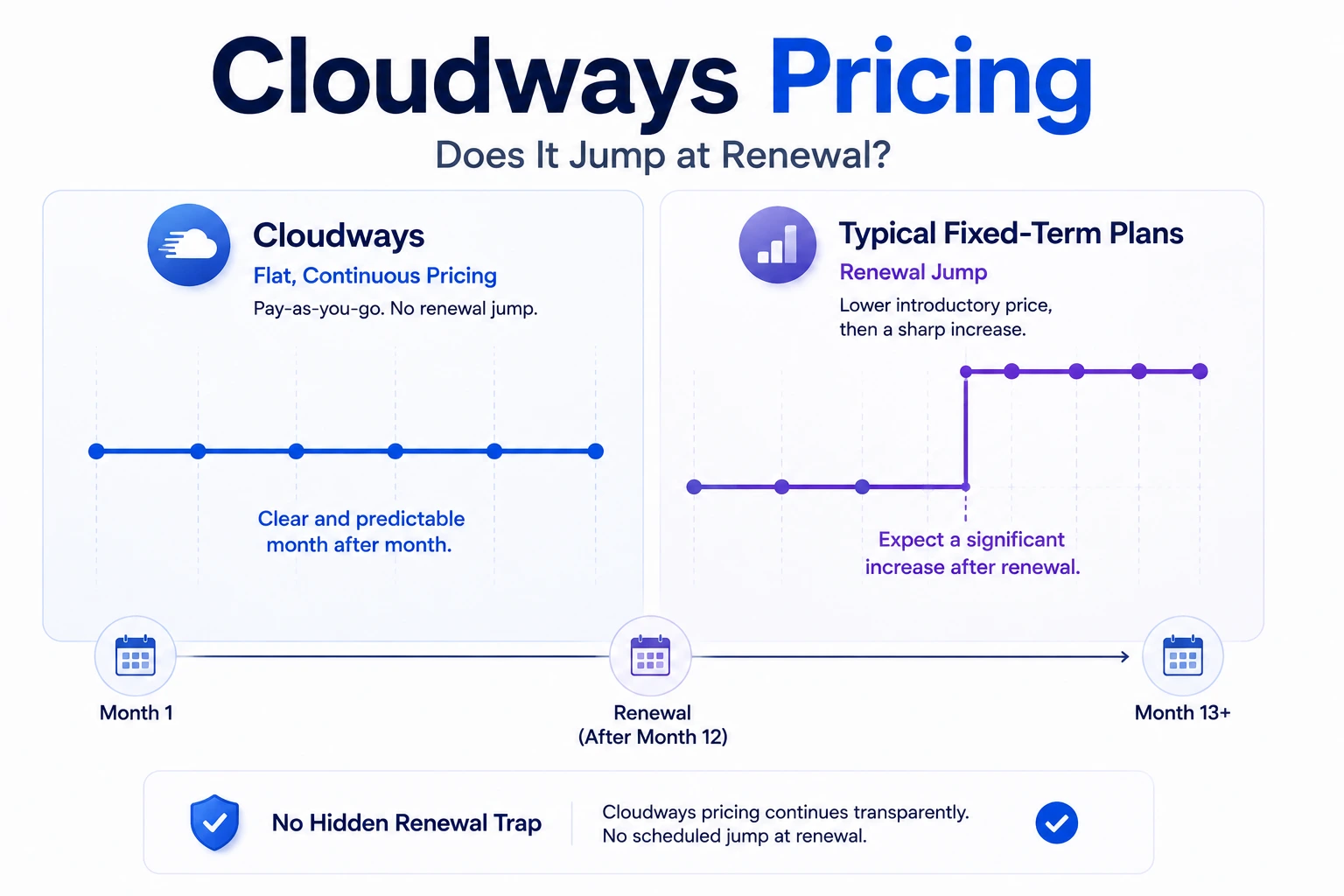
A real pattern exists among some hosting providers: a low, attractive signup price that quietly jumps — sometimes 3-4x — once the first billing term ends. It's a legitimate thing to check before committing to any host, and it's a fair question to ask about Cloudways specifically. We checked directly against Cloudways' own current pricing pages and billing documentation, rather than assuming the answer either way.
The short answer
Cloudways doesn't have a renewal-price mechanism at all — not "a small one," not "a hidden one," structurally none, for a specific reason: there's no fixed term to renew into. Flexible plans are billed hourly and invoiced monthly for actual usage; Autonomous plans are flat monthly tiers charged at the same rate regardless of how long you've been a customer. Confirmed directly on cloudways.com/en/pricing.php, checked 2026-08-26.
Why Flexible plans structurally can't have a renewal shock
Cloudways' own pricing page states it plainly: "Cloudways charges you hourly. This means you are charged only for what you use." Billing is post-paid — "we use post-billing method and charge in arrears. Invoices are issued in the first week of every month for usage of services in the previous month" (confirmed directly, checked 2026-08-26; see Cloudways Pricing Explained for the full tier ladder this hourly rate maps to, from $11/mo at the 1GB tier up).
This matters mechanically, not just as a reassurance: a renewal-shock pattern requires a term to renew — a 12-month contract that ends and restarts at a new rate. Hourly, pay-as-you-go billing doesn't have a term boundary at all. There's no month-13 event where a different price kicks in, because there's no month-1-through-12 contract in the first place.
Why Autonomous plans don't either
Cloudways' WordPress-specific Autonomous line (Growth $99/mo, Scale $199/mo, Plus $399/mo — confirmed directly, checked 2026-08-26) is billed as a flat monthly tier. The pricing page contains no mention of tenure-based pricing differences — a customer on their first month and a customer on their thirtieth pay the identical listed rate for the identical tier. See Cloudways Pricing Explained for what each Autonomous tier includes.
The one real exception: April 2023
To be precise rather than absolute: Cloudways has raised prices before. In April 2023, it implemented a company-wide price increase — the first since 2017 — applied identically across new and existing customers, publicly announced via its own blog (cloudways.com/blog/updated-pricing-plans/). This is a real, disclosed fact, not something we're glossing over to make a cleaner claim.
What makes this structurally different from a renewal-shock trap: it wasn't triggered by any individual account's billing anniversary, it wasn't a steep multiple (a modest, blanket adjustment, not a 3-4x jump), and it applied to every customer at the same time rather than ambushing whoever happened to be renewing that month. A company raising its published prices at some point is a normal business reality, not a bait-and-switch mechanism — the distinction this article is making is about the mechanism, not a claim that prices are frozen forever.
What this looks like elsewhere, for comparison
CHOICEA's own Cloudways vs WP Engine comparison already documents this directly for WP Engine: its listed prices ($30/mo Startup, $55/mo Professional, and up) are explicitly labeled on WP Engine's own pricing page as "first-year pricing," valid for new customers on annual billing — WP Engine's page states this is distinct from the renewal rate but doesn't publish that renewal number itself.
SiteGround's pattern is more explicit and, checked directly today (siteground.com/wordpress-hosting, 2026-08-26), considerably steeper: its StartUp plan lists $3.99/mo with the disclaimer "Renews at $17.99/mo. Prepaid for 12 months" — a 4.5x jump. GrowBig goes from $6.69/mo to $29.99/mo at renewal (also 4.5x), and GoGeek from $10.69/mo to $44.99/mo (also 4.2x). These aren't obscure fine print — they're stated directly on SiteGround's own pricing page, and they're exactly the pattern this article is checking Cloudways against.
Cloudways' $11/mo entry Flexible tier carries no equivalent asterisk, because there's no first-year/renewal split to disclose in the first place.
What can still make your bill go up (this isn't "price never changes")
Being precise here matters more than sounding reassuring:
- Your own usage growth increases your bill — more traffic, more storage, or a bigger server tier all cost more, the same way they would with almost any usage-based provider. That's a cost you're choosing by scaling, not a renewal trap.
- Add-ons cost extra — Advance Support, Cloudflare Enterprise, backup storage beyond the default, and similar features are separately priced. See Cloudways Hidden Costs for the full add-on breakdown.
- Autoscaling on Autonomous bills for what it uses during a spike — see Cloudways Autoscaling: How the Billing Actually Works for the per-pod mechanics.
- Cloudways could raise prices company-wide again — the April 2023 precedent shows this isn't off the table structurally, the same way it isn't for any company. What's specifically absent is a per-account renewal-anniversary price jump.
Who this matters most for
- Anyone who's been burned before by a "cheap first year, brutal renewal" host and wants to confirm Cloudways doesn't work that way before committing.
- Anyone comparing Cloudways against a host with disclosed first-year/renewal pricing (WP Engine, SiteGround) and wants to price the comparison honestly rather than dollar-for-dollar on headline numbers that mean different things.
- Anyone budgeting past month 12 and wanting to know whether their monthly number is stable by design, not just by luck so far.
Alternatives
If you're actively choosing between Cloudways and a host with disclosed first-year pricing, see Cloudways vs WP Engine for the fuller comparison, including this exact pricing-structure difference. If you haven't yet decided whether Cloudways is the right category at all, see Who Should (and Shouldn't) Use Cloudways for that upstream decision first.
If this option fits you
Check Cloudways' standard pricingPR / This link goes to our partner's official site (affiliate link). We may earn a commission if you make a purchase, at no extra cost to you. Pricing and promotions may change — please check the official site for current terms.
FAQ
Will my Cloudways bill jump after 12 months?
Not from a renewal mechanism — there isn't one. Flexible plans have no fixed term to renew into (hourly, pay-as-you-go billing), and Autonomous tiers are flat regardless of tenure. Your bill can still change if your own usage grows or you add paid features, but that's a different thing than a scheduled renewal-price increase.
Has Cloudways ever raised its prices?
Yes, once — a company-wide increase in April 2023, the first since 2017, publicly announced and applied to all customers identically. This wasn't a per-account renewal trap; it was a disclosed, blanket rate change.
Is this the same as SiteGround or WP Engine's pricing model?
No. SiteGround explicitly publishes a renewal price alongside its introductory rate (e.g. $3.99/mo renewing at $17.99/mo, confirmed directly on its pricing page). WP Engine labels its listed prices as first-year rates without publishing the renewal number. Cloudways' Flexible tiers have neither an introductory rate nor a disclosed renewal rate, because the billing model itself doesn't have that two-tier structure.
Sources
- cloudways.com/en/pricing.php — hourly/pay-as-you-go billing description, post-billing/arrears invoicing, current Autonomous tier prices, fetched directly and checked 2026-08-26
- cloudways.com/blog/updated-pricing-plans/ — April 2023 company-wide price increase, checked 2026-08-26
- wpengine.com/plans/ — first-year-pricing disclaimer, fetched directly and checked 2026-08-26
- siteground.com/wordpress-hosting — introductory-vs-renewal pricing disclosure, fetched directly and checked 2026-08-26
- CHOICEA's own Cloudways vs WP Engine and Cloudways Pricing Explained — referenced here rather than re-derived
Checked at: 2026-08-26. Pricing structures and promotional terms change on any provider — confirm current terms directly before committing to a plan.